








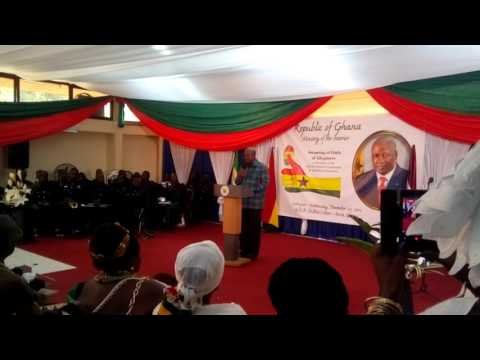
President Mahama Speaks Out! Reparative Citizenship for the Historic Diaspora Is a Right!
Recorded and transcribed by Ɔbenfo Ọbádélé Kambon
28 December 2016
So let me say: this is the first ceremony—such ceremony—I’m attending, and I do it in honor of our brothers and sisters who today are being given Ghanaian citizenship.
The slave trade still remains the most evil act ever perpetrated by humans on other humans. Nothing in the history of mankind beats the evilness of the slave trade.
We all are reminded when we see the symbols of this trade dotted along the coast of Africa, and especially along the coast of Ghana. Ghana has more slave forts than any other country in Africa. And so it means that Ghana was an important exit route for most of our brothers and sisters who ended up in the diaspora as slaves.
When you stand at the Cape Coast Castle or the Elmina Castle—when you stand in that archway that we call the Door of No Return—and you walk through the dungeons of these forts and castles, no sense of human imagination can capture the reality of the horror that took place in these forts and castles.
Families separated from each other forever. The Atlantic Ocean was a huge chasm that divided the African continent from the New World—the so-called New World. And indeed, once you walked through that door, there was no possibility of return at the time.
Indeed, as a young man growing up, aside from visiting the castles, the first real impact and understanding of the reality of the slave trade—apart from reading it in my history books in school—was the beautiful work done by Alex Haley, Roots, which we watched in several parts when I was a young undergraduate student in the University of Ghana.
The story of Kunta Kinte impacted and had such an effect on us, and made us truly understand the horror of what had taken place against our ancestors and forebears.
And one thing has always struck me about the common design of those slave forts and castles. And that is that both in the Osu Castle—which we have vacated currently and moved the seat of government to the Flagstaff House—and also in the Cape Coast Castle, you find that the chapel, where praise is given to God, and where humanity should be in supplication with its Creator, is built over the dungeon where unspeakable horrors were taking place.
And so even as the priest or whoever was administering the sermon, he couldn’t fail to remember that there were people underneath his feet suffering utter, utter, utter humiliation and suffering.
Today we are here to turn that Door of No Return into a door of return.
It’s a great privilege. Excellency, the Ambassador gave me the visitor’s book of the diaspora embassy to fill when I arrived here on the grounds of Du Bois Center. And I said: “I have the honor and privilege to restore to you your full rights as Ghanaian and African citizens.”
So let me say: in doing this, I deserve no thanks or praise, because I’m giving back to you what rightfully belong to you.
And in doing this, I’m just following in the footsteps of our fathers: Dr. Nkrumah, Padmore, Garvey, Du Bois, Martin Luther King, and all of them. We’re just following in their footsteps.
Ghana was the first sub-Saharan African country to break free from colonial domination. And since then it had been the beacon of the liberation struggle.
We believed, as President Nkrumah said, that independence of Ghana is meaningless unless it’s linked with the total liberation of the African continent. And so Ghana became the headquarters of the liberation struggle.
And I felt proud as the President of Ghana when I’m going to other countries and had the presidents walk up to me and tell of how they lived in Ghana, and they remember Osu, and they remember some of the nightclubs they used to go to here. And they proudly tell me that: “I still have my Ghanaian passport that Dr. Nkrumah gave to me.”
And so Ghana has continued to be that beacon that promotes Pan-Africanism. And so, in signing these instruments of citizenship, I’m just following in the footsteps of what the founder of our nation began, Dr. Kwame Nkrumah.
In July this year, we passed another historic legislation that gives all Africans, all persons carrying passports of African countries, the right to apply for visas on arrival. And that has facilitated travel of Africans into Ghana.
I believe that this privilege can be extended to the diaspora to allow all persons, you know, of the diaspora—Africans—to be able to visit not only Ghana, but all other African countries, without the necessity of having to travel to embassies abroad to apply for visas.
I do believe that this is a win-win. Our brothers and sisters who live in the diaspora have acquired skills that are useful to the motherland. And so by allowing you to come and go freely, and even to reside, you bring back those skills to the motherland and help us to develop our continent.
And so let me congratulate those of you who are receiving citizenship today. I believe you’re not going to be the last. This should be the first.
And I’d just like to say that the minister read the act which has some very inimical and unpleasant things in there, but it will not come to that. It’s your right. You’re Ghanaians. You’re gonna live here. You’re gonna live as brothers and sisters. And you’re gonna be forever.
And so on behalf of the government and your brothers and sisters, Ghanaians, I wish to warmly welcome you back home.
And to say that, as we say in the Akan language: Akwaaba.
And it is my hope that this citizenship that has been restored to you will be one that will be beneficial to you coming home, and those of us here. I believe that you bring back some of the benefits of learning, of science, and so many things back home. And I believe and hope that it will be of benefit to your brothers and sisters you left back home.
Thank you very much. May God richly bless all of you. Thank you.
